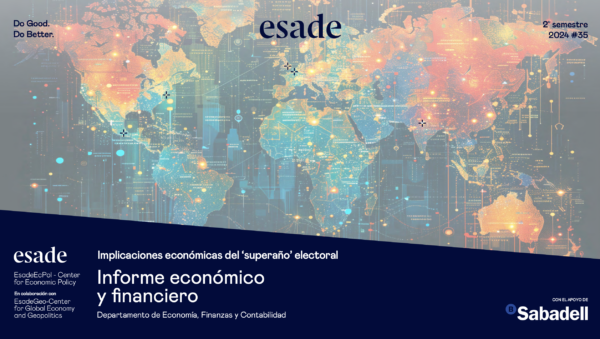
Informe Económico y Financiero #35
Toni Roldán, Josep Mª Comajuncosa, Manuel Hidalgo Pérez, Antonio García Maldonado
11 Jul, 2024
Every six months Esade publishes, with the support of Banco Sabadell, the Informe Económico y Financiero (Economic and Financial Report), which will soon turn twenty. With this report Esade seeks to stay true to its mission and contribute to society with what it does best: providing knowledge to improve public debate. The Report thus aims to offer a snapshot of the global and Spanish economic landscape and, in each edition, focuses on an issue of particular relevance to current economic affairs. This 35th edition includes an analysis of the current situation and trends of the Spanish and international economy for the second half of 2024, and looks in depth at the economic implications of the electoral super-year that 2024 is turning out to be.
Toni Roldán, director of the Informe Económico y Financiero and of EsadeEcPol, highlights in his welcome article the resilience of the international economy, underlining the strong growth (above expectations) of the Spanish economy. Next, Josep Comajuncosa, associate professor in Esade’s Department of Economics, Finance and Accounting, presents the analysis of the international economic situation. Second, Manuel Hidalgo, professor of Economics at Pablo de Olavide University, senior fellow at EsadeEcPol and co-director of the NextGenEU Observatory, sets out the factors that allow Spain to maintain a stronger profile than our neighbours, but also reviews the challenges ahead, with a special focus on investment, fiscal policy and productivity.
In the following section, four articles analyse in detail the economic implications of the many elections taking place in 2024. Antonio Barroso, managing director at Teneo for the Eurozone and adjunct professor at Sciences Po, opens by anticipating the impact on the trajectory of European economic policy of the new cycle that begins after the European Parliament elections of 6-9 June. Ángel Saz (professor at Esade and director of EsadeGeo) and Mateu Tomí (from the Center’s research team) follow, discussing the consequences that a possible return of Donald Trump to the US presidency could have for the global economy. Alicia García Herrero, senior fellow at Bruegel, draws on her experience in Asia to explain how the Chinese leadership could respond in terms of trade, defence, technology and industrial policy to a more populist political cycle in Western democracies. Vicente Bermejo, assistant professor of Finance at Esade and member of GREF, closes the section by drawing on his research to discuss the implications of a more uncertain political cycle for the likelihood of undertaking aid and fiscal consolidation plans.
Finally, Antonio García Maldonado reviews “The Gilded Cage: Technology, Development and State Capitalism in China” by Ya-Wen Lei and “¿Una nueva crisis?” by José María O’Kean, two books published this year.

Profesor titular del Departamento de Economía,Finanzas y Contabilidad de Esade
View profile

Profesor de sistemas políticos e institucionales comparados en el Master Global en Asuntos Públicos del IMF y la Universidad de Nebrija
View profileRelated content

24 Mar, 2026