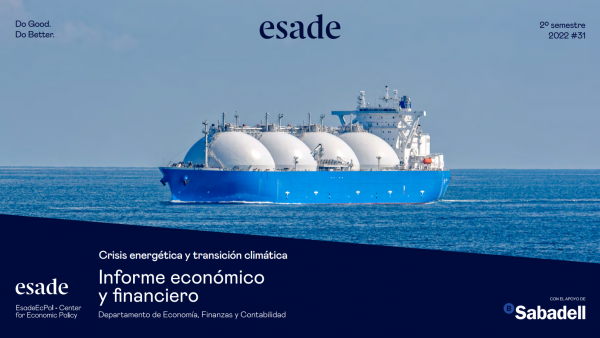
Informe Económico y Financiero #31
Toni Roldán, Josep Mª Comajuncosa, Manuel Hidalgo Pérez, Elina Ribakova, Benjamin Hilgenstock, Jesús Fernández-Villaverde, Antonia Díaz, Luis Puch, Luca del Viva, Antonio García Maldonado
13 Jul, 2022
For more than fifteen years, every six months Esade has published the Informe Económico y Financiero (Economic and Financial Report) with the support of Banco Sabadell. The Report aims to offer a snapshot of the global and Spanish economic landscape and, in each edition, focuses on an issue of particular relevance to current economic affairs. Esade seeks to stay true to its mission and contribute to society with what it does best, providing knowledge to improve public debate. This 31st edition includes an analysis of the current situation and trends of the Spanish and international economy and in-depth articles on the energy crisis and the climate transition.
Toni Roldán, director of the Informe Económico y Financiero, takes stock of how the situation has evolved over the year and sets out the main threats to growth in the coming months in his welcome article. This is followed by the analysis of the international economic situation by Josep Comajuncosa, associate professor in Esade’s Department of Economics, Finance and Accounting, who warns about the impact of inflation and, in particular, the difficulties arising from the high level of global debt. Second, Manuel Hidalgo, professor of Economics at Pablo de Olavide University, senior fellow at EsadeEcPol and co-director of the NextGenEU Observatory, paints a relatively favourable short-term scenario for the Spanish economy and a less optimistic one in the medium term.
In the debate section, the authors address the dual challenge of the energy crisis and the climate transition from different perspectives. First, Elina Ribakova and Benjamin Hilgenstock, Deputy Chief Economist and Associate Economist, respectively, at the Institute of International Finance, write about the cost of energy security in the European Union. Meanwhile, Jesús Fernández-Villaverde, professor of Economics at the University of Pennsylvania, writes about the challenges and dilemmas arising from the European Central Bank’s new strategy, which considers climate change a key factor in the formulation of eurozone monetary policy. They are followed by Antonia Díaz, associate professor in the Department of Economics at Carlos III University of Madrid, and Luis Puch, professor of Economic Analysis in the Department of Economic Analysis at the Complutense University of Madrid, who propose a series of emergency measures in response to the current energy shock. Finally, Luca del Viva, associate professor in Esade’s Department of Economics, Finance and Accounting, writes about the effects of companies’ green transition commitments on their results and risks.
Lastly, Antonio García Maldonado reviews two books: «Principles for Dealing with the Changing World Order» by Ray Dalio and «The Man Who Broke Capitalism» by David Gelles.
Profesor titular del Departamento de Economía,Finanzas y Contabilidad de Esade
View profile

Nonresident Senior Fellow, Peterson Institute for International Economics & Bruegel; VP Foreign Policy & Director of International Affairs Program, Kyiv School of Economics
View profile

Profesora titular del Departamento de Economía de la Universidad Carlos III de Madrid.
View profile
Profesor titular del Departamento de Economía,Finanzas y Contabilidad de Esade.
View profile
Profesor de sistemas políticos e institucionales comparados en el Master Global en Asuntos Públicos del IMF y la Universidad de Nebrija
View profileRelated content