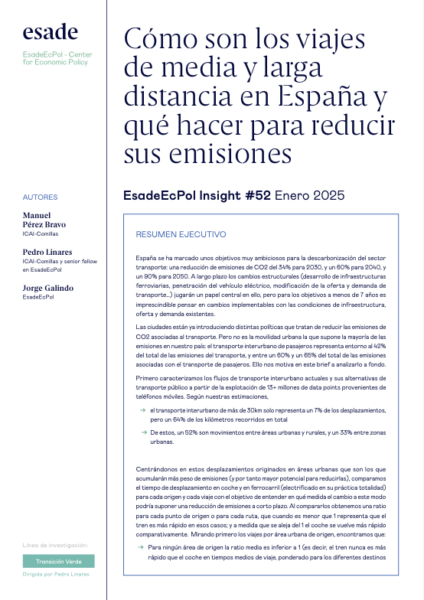
How are medium and long-distance trips in Spain, and what can be done to reduce their emissions?
Manuel Pérez Bravo, Pedro Linares Llamas, Jorge Galindo
30 Jan, 2025
Spain has set very ambitious goals for the decarbonization of the transport sector: a 34% reduction in CO2 emissions by 2030, 60% by 2040, and 90% by 2050. In the long term, structural changes (development of railway infrastructure, penetration of electric vehicles, modification of transport supply and demand…) will play a central role in achieving these targets. However, for goals within the next 7 years, it is essential to consider changes that can be implemented within the existing infrastructure, supply, and demand conditions.
Cities are already introducing various policies aimed at reducing CO2 emissions associated with transport. However, it is not urban mobility that accounts for the majority of emissions in our country: intercity passenger transport represents around 42% of total transport emissions, and between 60% and 65% of total passenger transport emissions. This motivates us to analyze it in-depth in this brief.
First, we characterize current intercity transport flows and their public transport alternatives based on the analysis of 13+ million data points from mobile phones. According to our estimates:
– Intercity transport for distances greater than 30 km represents only 7% of trips, but accounts for 64% of total kilometers traveled.
– Of these, 52% are movements between urban and rural areas, and 33% between urban areas.
Focusing on trips originating from urban areas, which account for the highest emission loads (and therefore the greatest potential for reduction), we compare travel times by car and by rail (electrified almost entirely) for each origin and trip to understand to what extent switching to this mode could result in short-term emission reductions. Comparing them, we obtain a ratio for each point of origin or each route: when the ratio is less than 1, it means that the train is faster in those cases; and as it moves away from 1, the car becomes relatively faster. Looking first at trips from urban areas of origin, we find that:
– In no area of origin is the average ratio lower than 1 (that is, the train is never faster than the car in terms of average travel times, weighted for different destinations from the same origin). However, for 25 out of 74 analyzed areas, the ratio is below 2, suggesting that for one-third of urban areas, the train could be a competitive alternative for all routes originating from them, which should be the focus of efforts.
– The train is less competitive for trips originating from urban areas farther from the center of the peninsula, reflecting the predominantly radial design of our infrastructure.
Additionally, we analyze data on a route-by-route basis (considering origin-destination pairs):
– On connections between urban areas with high-speed rail service, the correlation between the train/car time ratio and the percentage of travelers choosing the train is clear: where the train is faster, over 20% of trips are made by train.
– However, there is a group of high-speed routes where the ratio remains highly favorable to the car. In other cases, even where the train is favorable, cars are used over 80% of the time to cover these routes. It would be worth analyzing why high-speed rail is not absorbing sufficient demand in these cases.
– Across all routes, including those without high-speed rail service, under current infrastructure conditions, rail is competitive (in terms of travel time) for only a minority of trips between municipalities (urban or rural) over medium and long distances: only 18% have a ratio lower than 1.
This analysis allows us to make a series of recommendations to encourage modal shift in intercity transport:
– To decarbonize intercity transport, increasing energy efficiency is the most impactful measure, raising vehicle occupancy rates on both roads and railways.
— Secondly, decarbonizing each mode can follow different paths: rail is largely electrified in Spain, so with an increase in renewable energy penetration in the grid, a
large part of its decarbonization journey is already covered. However, road public transport still faces technological and infrastructure implementation challenges, which we will discuss below.
– For routes where rail is already competitive in terms of travel time compared to private vehicles, but continues to show low market shares, it is necessary to review frequencies, service availability, speeds, and pricing mechanisms. For example, routes with a ratio equal to or lower than 1 and a market share below 20%, such as Barcelona-Lleida, Seville-Córdoba, Madrid-Córdoba, Madrid-Pamplona, and Madrid-Granada.
– In areas where rail is not competitive, and always considering that some may become so with the right infrastructure changes, it will be advisable to make low-emission buses competitive. This implies promoting the deployment of such technologies (only 7.5% of the total fleet is decarbonized and concentrated in urban travel) and reviewing their pricing, which in many cases is not competitive with private vehicles.
– Developing incentives or promoting shared mobility systems to increase the occupancy rate of private vehicles in intercity travel, particularly on routes not served by public transport.
– Finally, it is crucial to accelerate the expansion of charging points for electric vehicles, particularly in areas with the greatest deficits (less dense regions), to encourage the use of these vehicles in intercity trips that lack public transport alternatives.

Su trabajo se enfoca en las futuras tendencias de transporte y en la evaluación y diseño de políticas para una transición energética sostenible.
View profile
Profesor en la Universidad Pontificia Comillas

Related content
3 Apr, 2025