A proposal to improve the efficiency of excise taxes in Spain: tobacco and sugar-sweetened beverages
Ángel Martínez Jorge, Francisco de la Torre
16 Sep, 2021
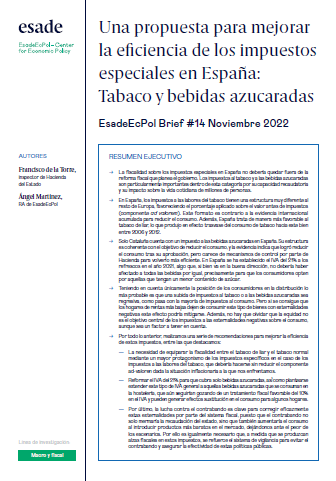
→ Excise taxation in Spain should not be left out of the tax reform planned by the government. Taxes on tobacco and sugar-sweetened beverages are particularly important within this category because of their revenue-raising capacity and their impact on the daily lives of millions of people.
→ In Spain, taxes on tobacco products have a very different structure from the rest of Europe, favouring the percentage applied to the pre-tax value (ad valorem component). This format runs counter to the accumulated international evidence on reducing consumption. In addition, Spain treats rolling tobacco more favourably, which led to a shift in tobacco consumption towards this product between 2006 and 2012.
→ Only Catalonia has a tax on sugar-sweetened beverages in Spain. Its structure is consistent with the goal of reducing consumption, and the evidence indicates that it succeeded in reducing consumption after its approval, but it lacks control mechanisms on the part of the Tax Agency to make it more efficient. In 2021 Spain introduced 21% VAT on soft drinks which, although a step in the right direction, should not have affected all drinks equally, precisely so that consumers opt for those with lower sugar content.
→ Taking into account only consumers’ position in the distribution, an increase in taxes on tobacco or sugar-sweetened beverages is most likely to be regressive, as is the case with most consumption taxes. But if lower-income households can be encouraged to stop consuming these goods with negative externalities, this effect could be mitigated. Moreover, we should not forget that equity is not the central objective of taxes on negative consumption externalities, even though it is a factor to be taken into account.
→ For all these reasons, we make a series of recommendations to improve the efficiency of these taxes, including:
- The need to equalise taxation between rolling tobacco and regular tobacco by giving greater weight to specific taxes in the case of taxes on tobacco products, which should be done without reducing the ad valorem component given the inflationary situation we face.
- Reforming the 21% VAT so that it only covers sugar-sweetened beverages, and considering extending this general VAT rate to sugar-sweetened beverages consumed in the hospitality sector, which would otherwise continue to enjoy favourable tax treatment at 10% VAT and could generate substitution effects in consumption for some households.
- Finally, the fight against smuggling is key for the tax system to effectively correct these externalities, since smuggling would not only reduce state revenue but also increase consumption by introducing cheaper products into the market, leaving us with the worst of all scenarios. It is therefore equally necessary that, as these taxes are raised, the monitoring system is strengthened to prevent smuggling and ensure the effectiveness of these public policies.