Informe Económico y Financiero # 38 · Europe, capabilities for a hostile world
Omar Rachedi, Jorge Galindo, Josep Mª Comajuncosa, Manuel Hidalgo Pérez
24 March 2026
Every six months, with the support of Banco Sabadell, Esade publishes the Informe Económico y Financiero (Economic and Financial Report), which now reaches its 38th edition under the title The Europe that is missing: capabilities for a hostile world. Through it, Esade maintains its commitment to contributing to public debate with rigorous and plural analysis which, as a prestigious school and with the involvement of its entire academic community, reinforces its commitment to economic and social progress.
In his welcome article, the Report’s academic director, Omar Rachedi, starts from an observation worth highlighting: Spain enters this year in a comparatively solid position, with GDP growing by 3.5% in 2024 and 2.8% in 2025, and forecasts of around 2.3% for 2026, figures that make it the most dynamic economy among the major eurozone powers. Rachedi warns, however, against complacency: around 60% of the recent expansion is explained by rising employment, and GDP per capita remains clearly below the European average. He also stresses that the economy can no longer be understood solely in terms of growth, inflation or employment, as geopolitics has returned to centre stage with hybrid warfare, technological coercion and the exploitation of strategic dependencies. The underlying message is twofold: there are solid reasons to acknowledge what Spain is doing well, but also to understand that prosperity will increasingly depend on the ability to combine openness and security, growth and productivity, competitiveness and democratic resilience.
Next, the economic outlook note, by Josep M. Comajuncosa and Manuel Hidalgo, first examines the international scenario, where the global economy has weathered with relative success the disruption of the Trump administration’s reciprocal tariffs, maintaining stable growth of 3.3% both in 2025 and in the forecasts for 2026 made before the conflict in the Middle East. The eurozone is posting weaker growth, of around 1.3%, while global inflation is trending downwards. The analysis identifies three major risks: the concentration of growth in a few sectors —especially AI—; a possible escalation of the trade war —with tariffs at their highest levels in a century and the recent ruling by the US Supreme Court declaring the levies imposed under the IEEPA illegal—; and the escalation of the conflict between the United States and Iran at the end of February 2026, which has de facto paralysed traffic in the Strait of Hormuz. The note then analyses the Spanish economic situation, where growth remains robust but predominantly extensive. Nonetheless, it highlights positive signs such as the rebound in Total Factor Productivity —the highest rate since 1995—, the current account surplus, private sector deleveraging and the boom in non-tourism services exports. Among the bottlenecks, the housing squeeze stands out, with prices rising by 12.9% year-on-year and an insufficient supply of new construction, as well as the unfinished business of fiscal policy, with public debt still well above the European average.
In the “Debate” section, four articles offer different perspectives on the European strategic challenge:
- Federico Santi, in “The EU’s long road towards ‘strategic autonomy’ in defence”, analyses the risks of Europe’s dependence on the US security umbrella, aggravated by Trump’s ambiguous stance on NATO. He estimates that defence spending should rise to 3.5-4% of GDP —roughly double the current level—, points to the deep fiscal divergences between Member States and warns that decoupling from US suppliers will be a process requiring at least two decades.
- Nicolás de Pedro, in “Europe facing the strategic challenge of ‘hybrid threats'”, explores how hostile actions —from disinformation campaigns and cyberattacks to sabotage of critical infrastructure— pose a potentially existential challenge to liberal democracies. He traces the origins of the concept from the immediate post-Cold War period and Russian strategic thinking, and concludes that the main challenge is the asymmetry of perceptions: while Russia operates in wartime mode, most European democracies act within a peacetime framework.
- Raquel Jorge Ricart, in “The EU’s technology agenda: five levers to create strategic indispensability”, identifies the priorities Europe should address in the technological sphere: regulatory simplification without giving up the European standard, scalability of the startup ecosystem, investment in market niches where indispensability can be created —as in the case of ASML—, budgetary coherence in innovation policies, and truly unified technology diplomacy. She concludes with a proposal for Spain to promote pilot projects through the European Competitiveness Lab.
- Omar Rachedi, in “When money becomes a weapon”, analyses how global financial interdependence creates points of vulnerability and power that can be used as geopolitical leverage. He organises these vulnerabilities into four dimensions —the dollar as geopolitical infrastructure, debt and reserves as leverage, technology and information, and the crypto ecosystem— and concludes that Europe must foster a competitive euro stablecoin industry, complete the banking union and lead in technological supervision, regulating with a scalpel rather than a hammer.
Finally, the report is completed with reviews by Antonio García Maldonado of two recent books:
- Hijos del optimismo, by María Álvarez (Editorial Debate, 2026), an essay arguing that the industrial era is exhausted and that the excess savings resulting from its success fuel successive bubbles —dotcom, mortgages, AI—, proposing a transition towards an era of abundance or “plutonomy”.
- El método Nvidia (The Nvidia Way), by Tae Kim (Editorial Deusto, 2025), which recounts Nvidia’s rise from graphics card manufacturer to critical infrastructure for artificial intelligence, and whose reading in 2026 takes on an inescapable geopolitical dimension: every advanced chip is today a piece on the board of great-power rivalry.
Profesor del Departamento de Economía, Finanzas y Contabilidad de Esade, senior fellow de EsadeGeo.
View profile
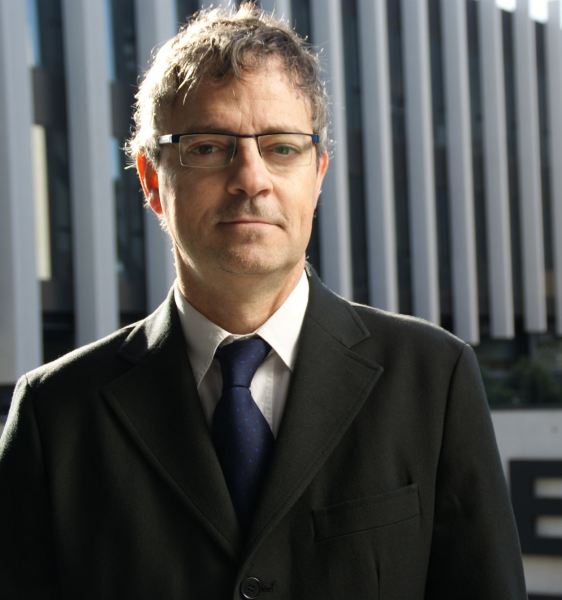
Profesor titular del Departamento de Economía,Finanzas y Contabilidad de Esade
View profile
Related content