How was inflation in 2025 for poor and rich households in Spain
EsadeEcPol
22 January 2026
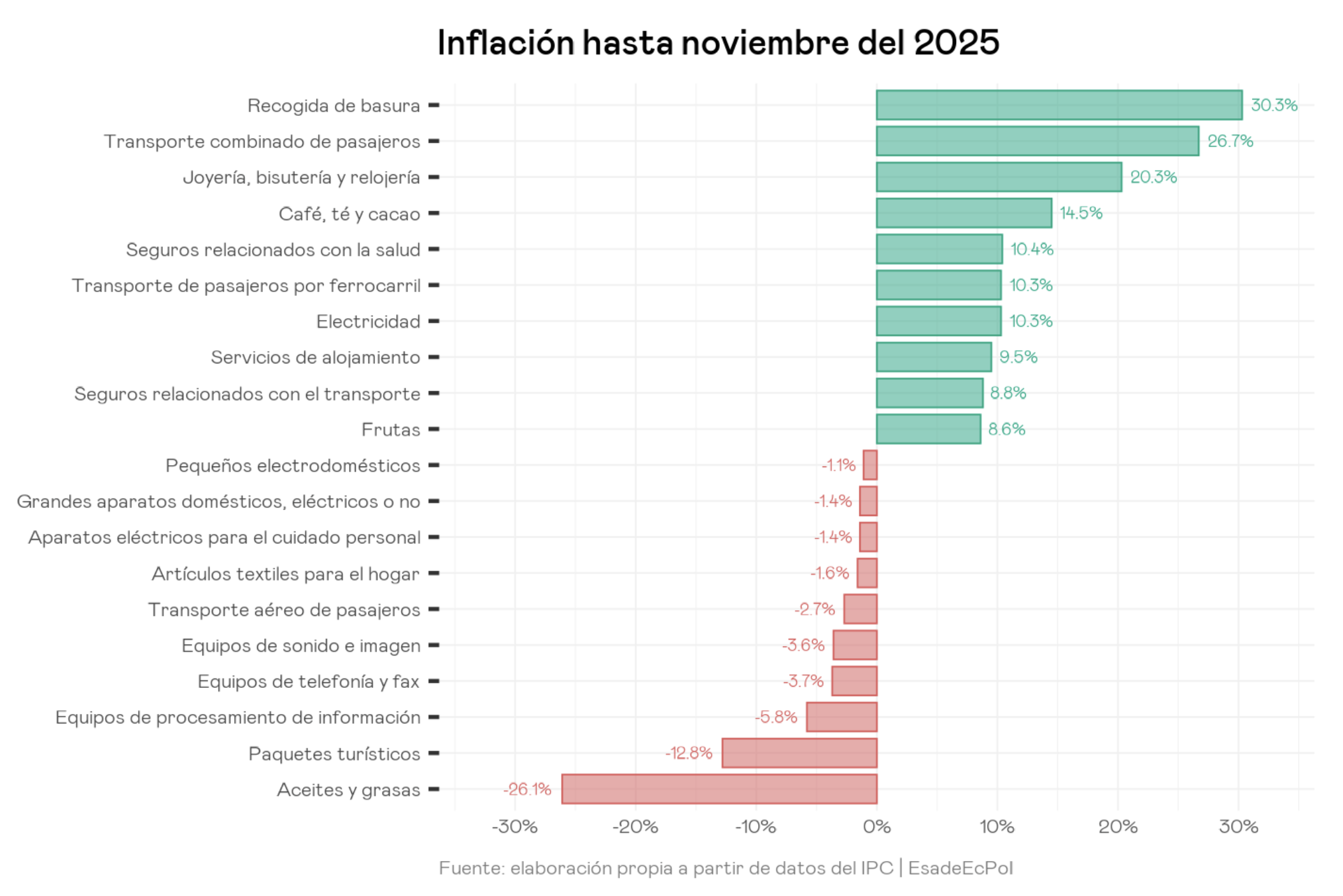
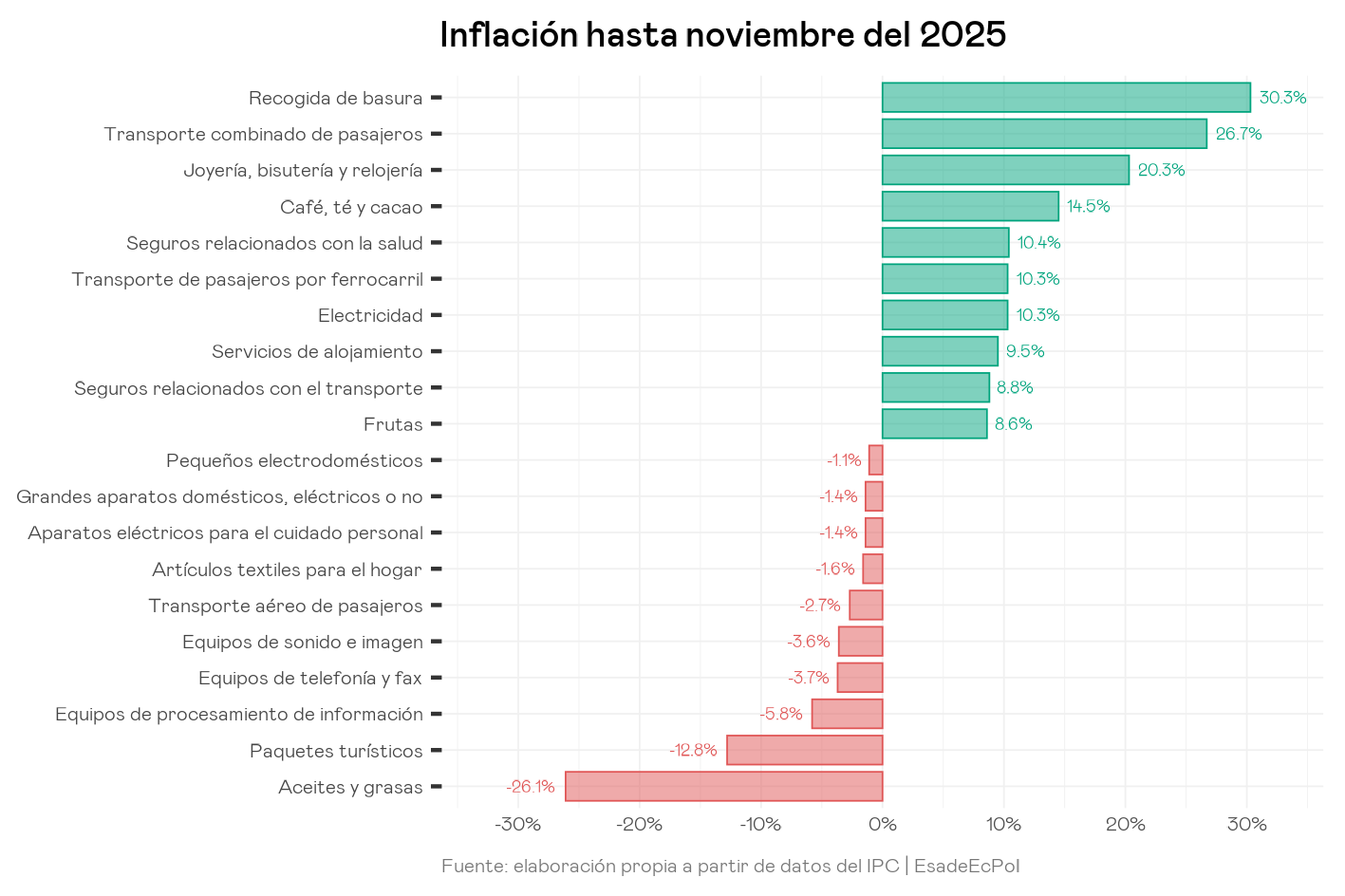
Inflation in 2025 is a long way from the inflationary peaks of the years immediately after covid-19, but it shares some features with the effects of inflation in recent years. According to the latest available data, the headline CPI reached 2.6% up to November 2025 and, as has been usual in recent years, with great heterogeneity across product groups. The groups of goods that recorded the largest price increases during 2025 include, among others, refuse collection services, driven by the revision of refuse charges in many municipalities (see here), combined passenger transport, coffee, tea and cocoa, health insurance, electricity and accommodation services. By contrast, package holidays and, especially, the oils and fats category are the ones whose prices have fallen the most, the latter driven by a 65% fall in olive oil which, as we shall see, will matter later on.
However, although this information on the CPI can give us an idea of whether price growth will weigh more heavily on the spending of households with fewer resources, estimating it properly requires turning to the microdata of the Household Budget Survey (EPF) in order to reconstruct an estimate of the CPI for the average household within each decile of equivalised expenditure, rather than for the average household at national level. The results indicate that price growth in 2025 weighed relatively more heavily on households with fewer resources, which faced inflation of 3% (decile 1) compared with 2.4% among households at the top of the distribution (decile 10).
We can divide the results into three main parts. On the one hand, the growth in food prices has a disproportionate impact on the poorest households because of the significantly greater weight of food in their consumption baskets. If we measure how much the growth in food prices in 2025 (oils and fats excluded) contributed to the inflation of each decile, we go from one point among the 30% of households with the least economic capacity to 0.5% in the last decile. However, this difference has been partly cushioned by the collapse in the price of olive oil, which has taken two tenths off the CPI among the first three deciles, and half that at the top of the distribution.
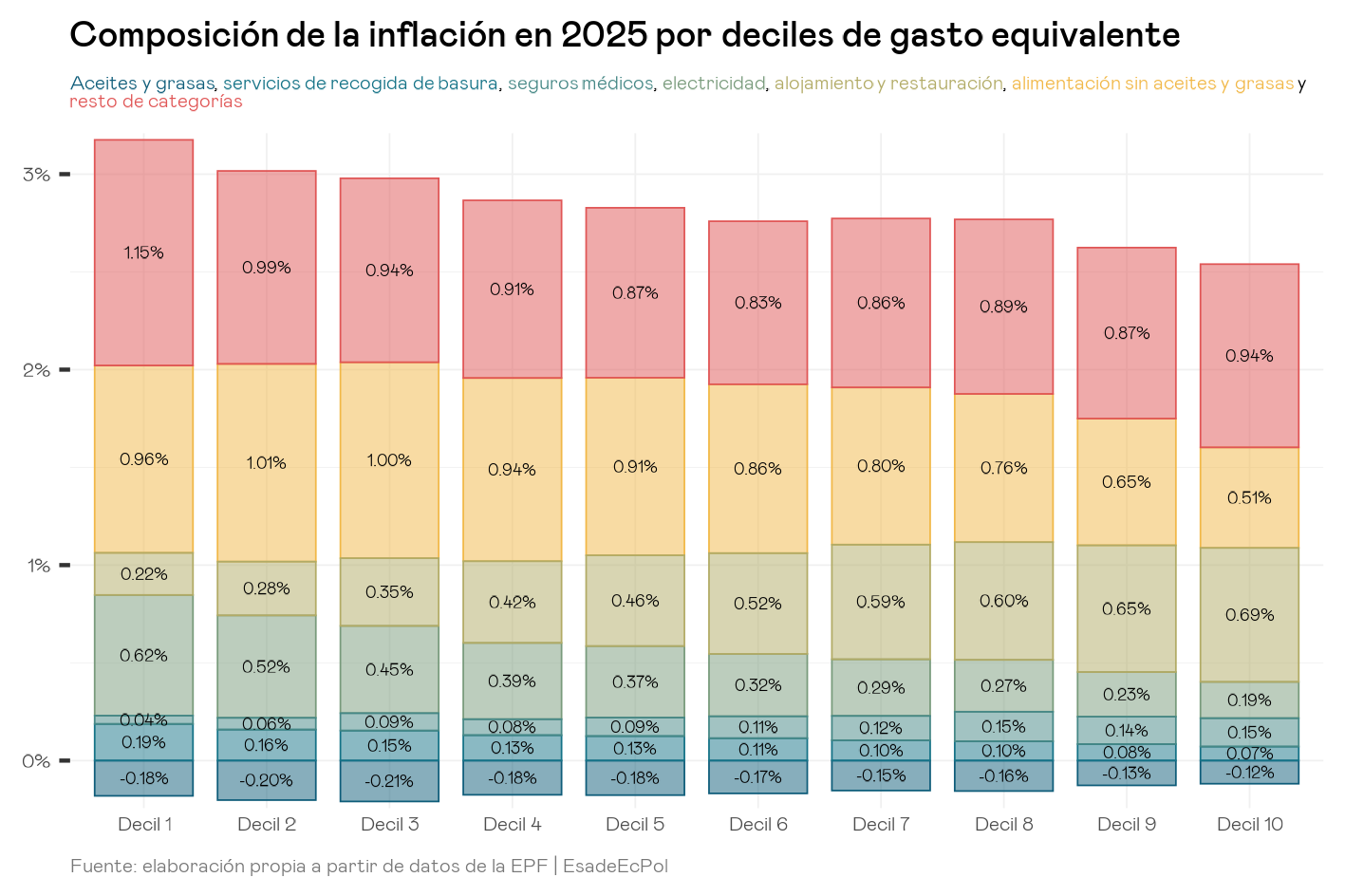
Second, we have the usual suspect, electricity. Already in 2024 the growth in the price of electricity was what, to a large extent, made the difference in the composition of the CPI across deciles, as a result of the partial restoration of VAT and of the special tax during that year. In 2025, the rise in VAT on electricity from 10% to 21% has once again generated a regressive impact that has added five tenths to the CPI among the lowest deciles and barely two among the highest, explaining almost half of the gap between the top and bottom of the distribution. On top of that, the equally negative distributional impact of the rise in refuse charges has been significant in 2025: despite their negligible weight in household budgets, the enormous price growth they have experienced (of 30%) has contributed around one more tenth to the inflation gap between deciles.
Finally, it is worth noting the impact, this time in the opposite direction, of one of the categories whose prices have been rising consistently above the headline CPI in recent years: restaurants and hotels. In 2025, the aggregate CPI for this category grew by 4.4%, driven especially by accommodation services, which became close to 10% more expensive, well above catering (4%). The two categories have added 0.65 points to the CPI of households with the greatest economic capacity, twice as much as at the bottom of the distribution. It is also worth highlighting the importance this year of private health insurance, whose price has grown by 10%, with a disproportionate impact on the CPI of households from the eighth decile upwards.
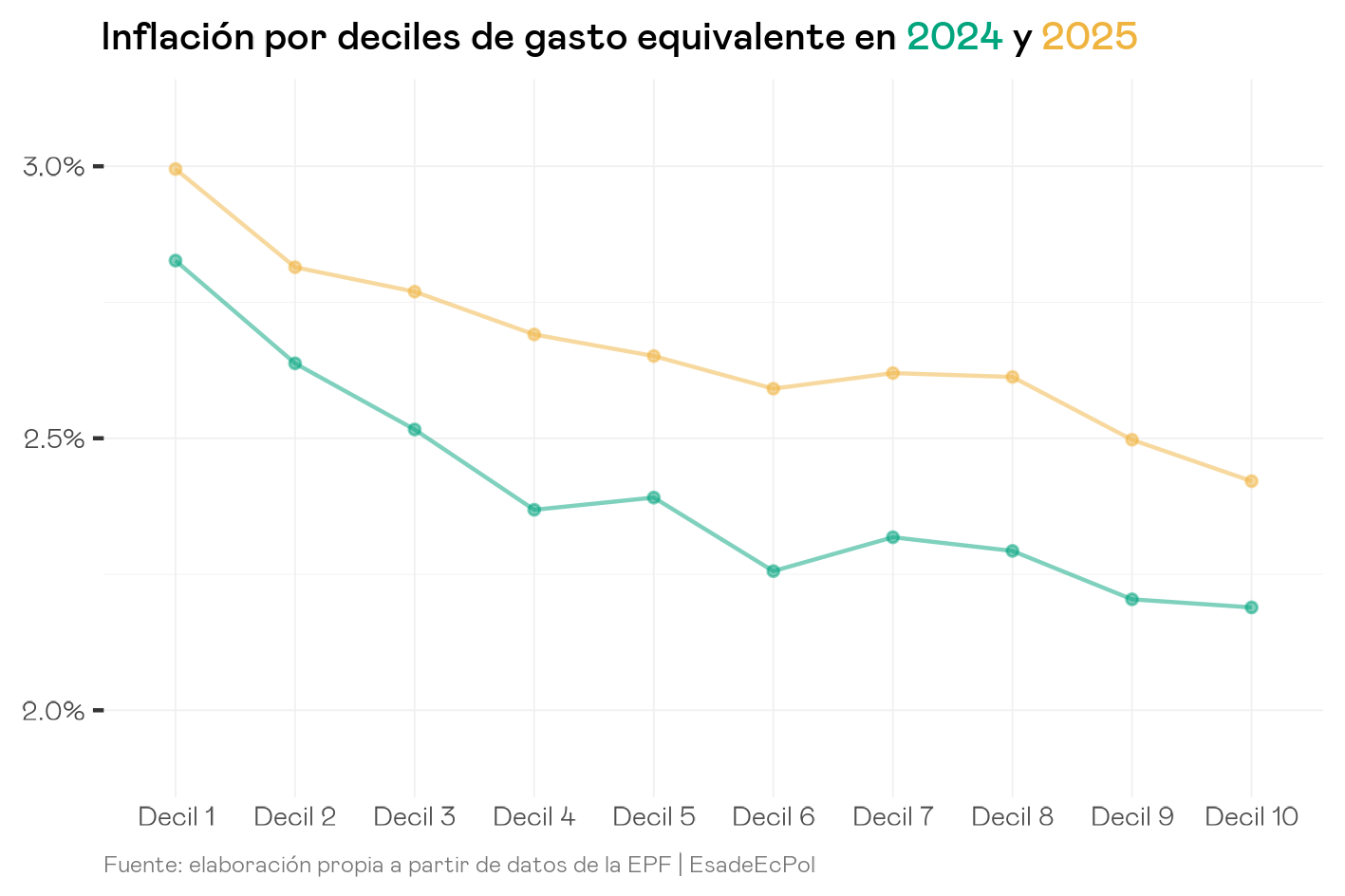
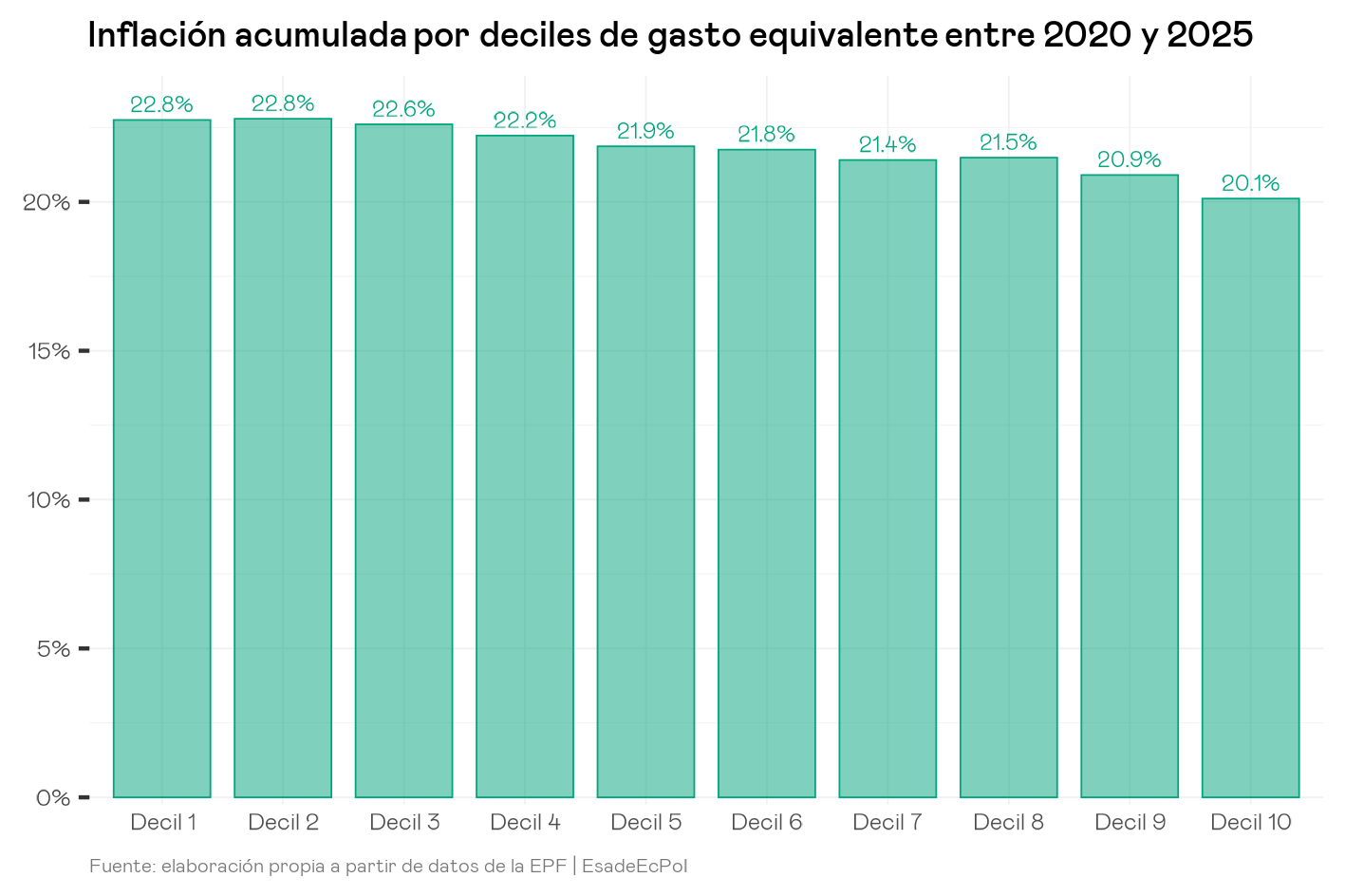
Although the sum of these differences seems small, their accumulation over recent years has resulted in a cumulative inflation gap between the extremes of the distribution of close to three points. It should also be remembered that this estimate does not take into account the heterogeneity of price changes that may exist within each category of goods and services, which unfortunately the INE does not break down. This is not a minor point, since, within the same product category, the prices that have risen most may have been those that were previously lowest and, therefore, inflation may also affect lower-income households through that route. In fact, this phenomenon, commonly known as cheapflation in English-speaking countries, has already been documented empirically (see here and here), including for Spain.
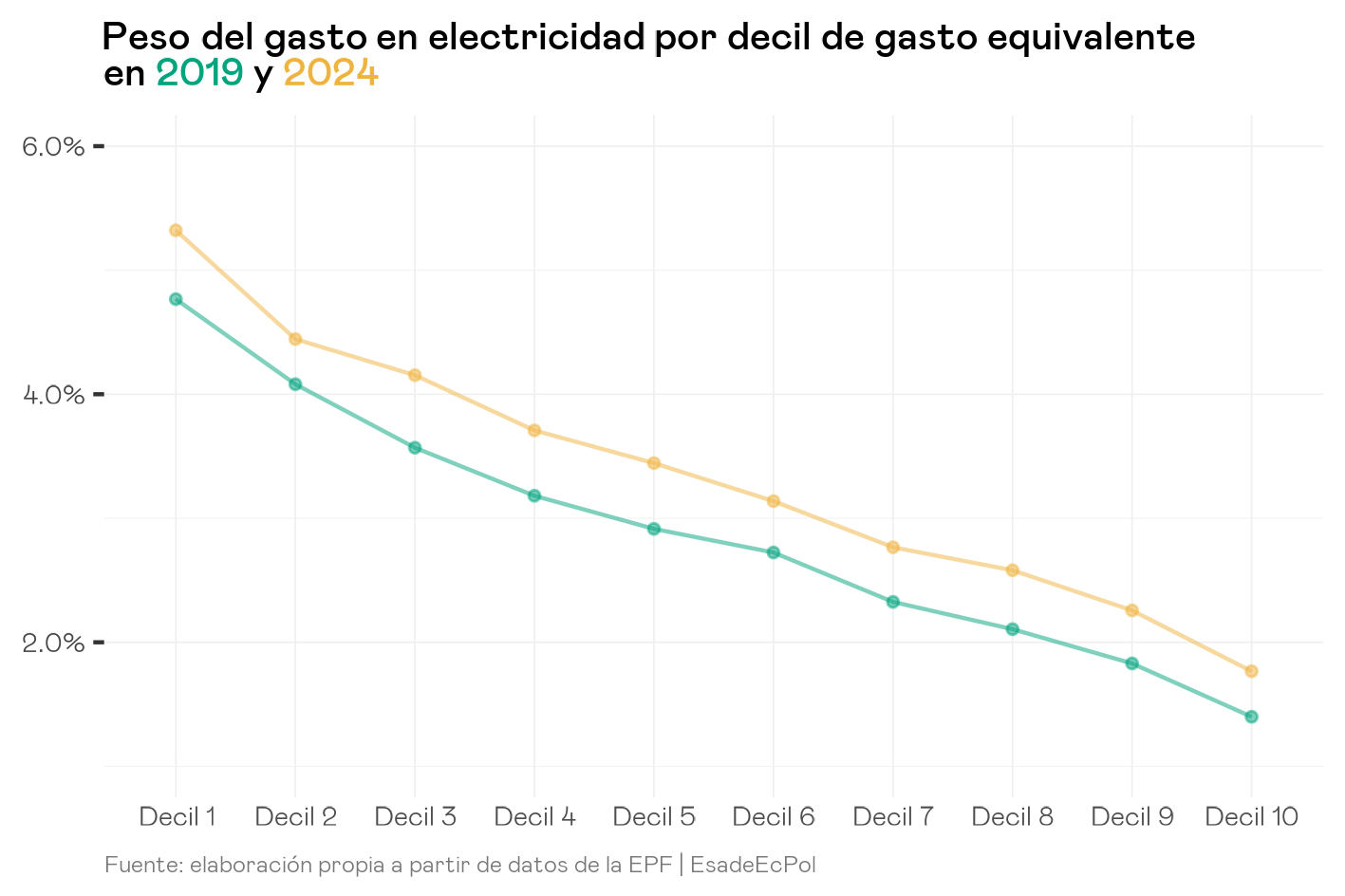
One of the most obvious policies that could have helped to reduce this unequal impact of inflation from 2020 onwards concerns the product that has, to a large extent, determined the difference in CPI between deciles in recent years: electricity. Between 2021 and 2023, the growth in the price of electricity prompted a cut in the three taxes on electricity: VAT (which went from 21% to 5%), the Special Tax on Electricity (IEE), which went from 5.3% to 0.5%, and the Tax on the Value of Electricity Production (IVPEE), which went from 7% to 0%. Between mid-2023 and 2025, all those cuts were fully reversed, which has meant a missed opportunity in two senses. First, the cut in indirect taxes on electricity (VAT and IEE) is probably among the fairest measures in distributional terms as far as cuts in indirect taxes are concerned, because of the enormous weight of electricity in the spending of households with fewer resources, which slightly exceeds 5% compared with less than 2% among the better-off. Second, a lower price of electricity is a factor that can encourage the electrification of households, an essential step in the energy transition.
Giving up both objectives for the sake of maximising tax revenue, in order to continue financing the growing expenditure arising from ageing, is yet another example of the public policy priorities that exist in Spain. However, it is never too late, and these policies continue to make the same sense today as when they were implemented on a temporary basis.
Related content