La plena disponibilidad, como requisito indispensable para la alta dirección, principal barrera de promoción según las directivas
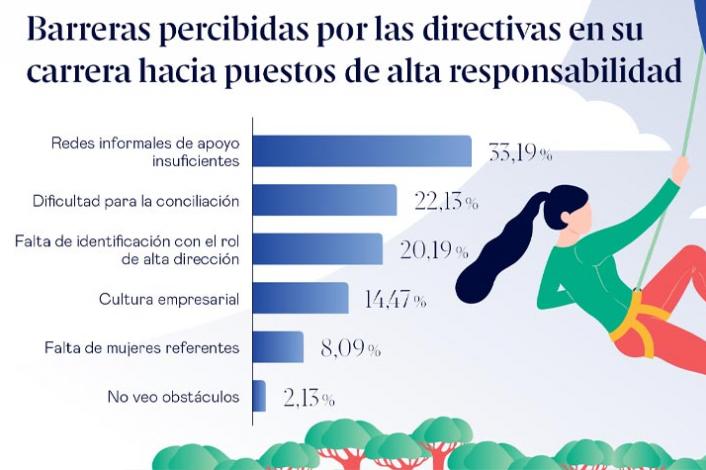
Las principales barreras que percibe la directiva a la hora de promocionar son las relacionadas con el modelo clásico de rol de género en la alta dirección, como la mayor dedicación de los hombres a las redes de apoyo (33,2%).
Gender equality has advanced considerably in business but there is still a tendency to regard complete availability as a must for senior management, and this benefits men more than women. This is one of the findings of the latest Esade Gender Monitor, which asked more than 800 female managers about the gender obstacles to promotion encountered in their companies.
In their opinion, although increasing numbers of companies include gender equality in their business strategy — up from 54.4% in the previous survey to 68.7% in the current one — and regard the work-life balance as a way of enhancing employees’ wellbeing or improving corporate productivity (69.4%), they still encounter stumbling blocks along the road to senior management, particularly in spheres concerning the time devoted to their job.
The main obstacles to promotion specifically mentioned by the female managers surveyed were that men devote more time to networking (33.2%), and the difficulty in combining the demands of their job with childcare (22.1%). These are followed by a failure to identify with the values they feel the company attributes to this group (20%), the business culture which they say assumes that a woman with children is less committed than a man (14.5%), and a lack of female role models in key jobs (8.1%).
According to Patricia Cauqui, co-author of this survey and academic director of Gender Balance and Diversity & Inclusion programmes at Esade, “the imbalance perceived by female executives stems from what they see as their companies’ expectations about greater availability, commitment and ambition amongst senior management. As long as this link persists between these expectations and a percentage of men willing to accept this model, one side will fuel the other”.
Covid-19, a trial by fire for teleworking
Meanwhile, as pointed out by Eugenia Bieto, co-author of the survey and director of the Esade Women Initiative: “Covid-19 has been a trial by fire for teleworking, and its implementation in companies will gather pace according to 86% of the female executives surveyed. They also believe that the pandemic is totally or partly responsible for teleworking taking root once and for all in their companies”.
Half of the female executives interviewed believe the best option would be for the company to let them choose their teleworking days on the basis of the targets and projects under way. A combination of teleworking days and days in the office would be preferred by 45.6%. Both suggestions might be feasible because three of every four participants said that their company had adapted to their family circumstances. Some interviewees (19.4%) said that striking a work-life balance was more difficult for them than for their colleagues, and others (28.4%), more difficult than for their partners.
When asked what measures could boost equal opportunities along their career path towards senior management more, they mentioned flexitime (20.9%), other policies such as senior management quotas (42.9%), positive discrimination (41.3%), and training to remedy subconscious bias (39.3%) or help them develop management skills (24.6%).
As regards the companies — 10.3% of which have an in-house, gender equality team — the most common measures mentioned by female executives were training (48.62%), the flexitime cited earlier (43.2%) and another key factor: schemes to encourage a sense of belonging (24.32%). Patricia Cauqui believes that these schemes “differentiate between complying with diversity ratios and managing to capitalise on this diversity to benefit the company. It’s a gradual behavioural change to make everyone feel part of the company”.
Gender equality in companies. The responsibility of all social agents
Encouraging co-responsibility between men and women in the home from public and private spaces is a pre-requisite, but insufficient to achieve gender equality in general, according to the female executives interviewed, who ranked it 8.63 out of 10. This is followed by the visibility of female role models in the media and culture (8.61), and measures to avoid gender discrimination at work (8.36). The fourth most important step towards achieving equality would be training and advice for women (8.17) and the fifth, legislation to combat sexual harassment and violence (8.04).
As regards the social agents most responsible for achieving gender balance, they rated private companies 9.19 out of 10, the Government (9.05), international bodies (8.92) and other agents. “These data reveal that the responsibility for gender balance is not just about companies but all social agents as a whole”, said Eugenia Bieto.
When asked to rate the real performance of these agents and others, e.g. the media, citizens’ movements and the tertiary sector, none scored more than 6 out of 10, except the performance of professional women’s associations, which scored 7.76. Associations of employers and trades unions scored poorly with 4.68 and 4.16, respectively.
About Esade Gender Monitor
The fifth Esade Gender Monitor is based on a survey carried out between May 1 and 30, 2020, using a questionnaire with 41 multiple-choice questions on the Qualtrics platform. The sample consisted of the students in the Promociona Project, an executive programme for senior management promoted by the Ministry of the Presidency, Relations with Parliament and Equality, via the Institute for Women and Equality, and coordinated by CEOE – whose academic partner is Esade. Of the 800 executives in this group, 293 answered the questionnaire. On the basis of the number of female executives according to the INE (Spain’s statistics bureau), i.e. 431,000 in 2019, the confidence level is 96% with a margin of error or ±6%. The interviewees are middle management or directors with more than 15 years’ experience. Esade Gender Monitor is a project run by the Esade Women Initiative within the framework of the United Nations’ #HeForShe movement.