
Choosing postgraduate education after gaining professional experience leads many professionals and executives to consider whether to pursue a specialized master’s degree or an MBA.
Although an MBA is, in fact, a type of master’s degree, the two serve different educational purposes. How can you tell which one is the right fit for you? The key is to understand what each one offers, where you are in your career, and what direction you want to take.
Below, we analyze the main differences between a master’s degree and an MBA to help you make a decision that allows you to take the next step and assume new management and leadership responsibilities.
What is an MBA?
MBA stands for Master of Business Administration. It is a master’s degree in business administration and management designed to provide a comprehensive view of business and develop managerial judgment and the ability to make complex decisions, a capability that is particularly relevant in contexts of uncertainty and when different business priorities compete.
In a context shaped by artificial intelligence, this judgment is even more important. The more powerful these technologies become, the more important it is to know what questions to ask, which recommendations to challenge, what risks to take, and how to integrate data, context, and ethical considerations to ultimately stand behind your decisions and take ownership of them.
Finance, strategy, marketing, operations, innovation, technology, leadership, and people management are some of the areas that typically come together in an MBA. However, its distinctive value does not simply lie in covering different business functions, but in understanding the organization as a whole, setting priorities, influencing different stakeholders, managing trade-offs, and making decisions whose consequences extend beyond a single area of specialization.
What is a master’s degree?
A master’s degree is a form of postgraduate education that allows participants to deepen their knowledge in a particular field or develop new professional skills, while also incorporating new tools and technologies, such as artificial intelligence, applied to that field.
There are different types of master’s degrees: many are geared toward specialization in a specific area, such as finance, marketing, business analytics, or operations, while others provide more general management education, such as the Master in Management (MiM).

Key differences between a master’s degree and an MBA
1. Participant profile
- Master’s degree: professionals who want to lead their functional area.
Based on Esade data, participants in specialized Executive Masters are 34–35 years old on average and have around 9–10 years of professional experience. They have generally built a career in a specific functional area, and want to deepen their expertise and prepare to lead it.
There are also specialized MSc (Master of Science) programs for recent graduates or junior professionals who want to become experts in a particular field from the beginning of their careers. - MBA: professionals who want to improve their cross-functional leadership, develop better decision-making skills, or pursue entrepreneurship.
In MBA programs, the profile varies depending on the format. In Esade’s Full Time MBA, participants are an average of 29 years old with 6 years of professional experience. In the Executive MBA, the average is 37 years old with 12 years of experience, and the part-time format allows participants to combine their studies with their professional work.
In both cases, the goal is to move toward more cross-functional leadership by integrating different perspectives and making decisions about the organization as a whole, or to pursue their own business venture.
Understanding the differences between an EMBA and an MBA can help you identify which format best fits your career stage.
Participant profiles for master’s degrees and MBAs at Esade
| Program | Average age | Average experience | Objective: key difference |
| MSc Masters of Science | 22-24 | 0-2 years | Specialize in an area and build expertise from the early stages of your career. |
| Executive Masters | 34-35 | 9-10 years | Deepen your expertise in an area, such as finance or operations, and prepare to lead it. |
| Full Time MBA | 29 | 6 years | Develop cross-functional leadership and managerial judgment to make decisions about the business as a whole or pursue your own business venture. |
| Executive MBA (Compatible with work) | 37 | 12 years |
2. Teaching method
Both specialized master’s degrees and MBA programs combine knowledge acquisition with applied learning through methods such as case studies, simulations, projects, and solving real business challenges. In an MBA, previous professional experience and the diversity of the group also add value to the learning experience: they allow participants to compare frameworks, decisions, and perspectives with people from different industries, functions, and international contexts (peer-to-peer learning).
The main difference between an MBA and a master’s degree lies in the perspective from which these challenges are approached:
- In a specialized master’s degree, learning allows participants to explore the problems, tools, technologies, and decisions specific to a particular area in greater depth, while also understanding how it relates to other functions and how it can contribute to the organization’s overall objectives.
- In an MBA, challenges are analyzed from a more cross-functional perspective, integrating different business functions from the outset to make decisions about the company as a whole.
3. Financial investment and expected return
Investment is another difference worth considering. At a prestigious business school such as Esade, Executive Masters generally cost around €30,000, while MBA programs require a higher investment: the Executive MBA costs around €74,000, and the Full Time MBA costs more than €80,000, depending on the edition.
When considering this investment, it is worth taking into account the effect it can have on career and salary progression. In Esade’s Executive MBA, the average post-EMBA salary increase is 30% in Spain and 52% internationally. For the Full Time MBA, the Financial Times 2026 rankings put the average salary increase three years after graduation at 155%.
It is also worth considering the available financing options, scholarships, and excellence awards, as these can reduce the investment required and form part of the decision.
4. Admission requirements
Requirements vary by school and program. For specialized master’s degrees, they may include an undergraduate degree, professional experience, language proficiency, and a selection process.
For Esade’s Executive Masters, for example, the minimum experience required depends on the program, with many requiring 5 years, and the process may include tests such as the Esade Admission Test (TAE), Executive Assessment (EA), GMAT, or GRE. The candidate’s career background, potential, and fit are also taken into account.
For MBA programs, in addition to an undergraduate degree, professional experience, English proficiency, and admission tests carry particular weight. Esade’s Full Time MBA requirements include a minimum of 2 years of full-time work experience, proof of English proficiency, and completion of the Esade Admission Test, GMAT, or GRE. For Executive MBA admissions, the minimum is 5 years of experience, and the process also includes an interview with the Admissions Committee.
Difference between the Master in Management and the MBA: a special case
The Master in Management (MiM) is a special case because, like the MBA, it provides broad-based business management education and allows participants to understand how the different functions of an organization relate to one another. The main difference lies in the participant’s background and career stage:
The MiM is generally designed for recent graduates or professionals in the early stages of their careers who want to build a solid foundation in management before gaining extensive experience.
The MBA, by contrast, builds on more extensive prior professional experience and uses it to develop more sophisticated managerial decision-making skills. Participants can compare theoretical frameworks with decisions they have already taken, mistakes they have made, organizations they have worked in, and leadership situations they have faced.
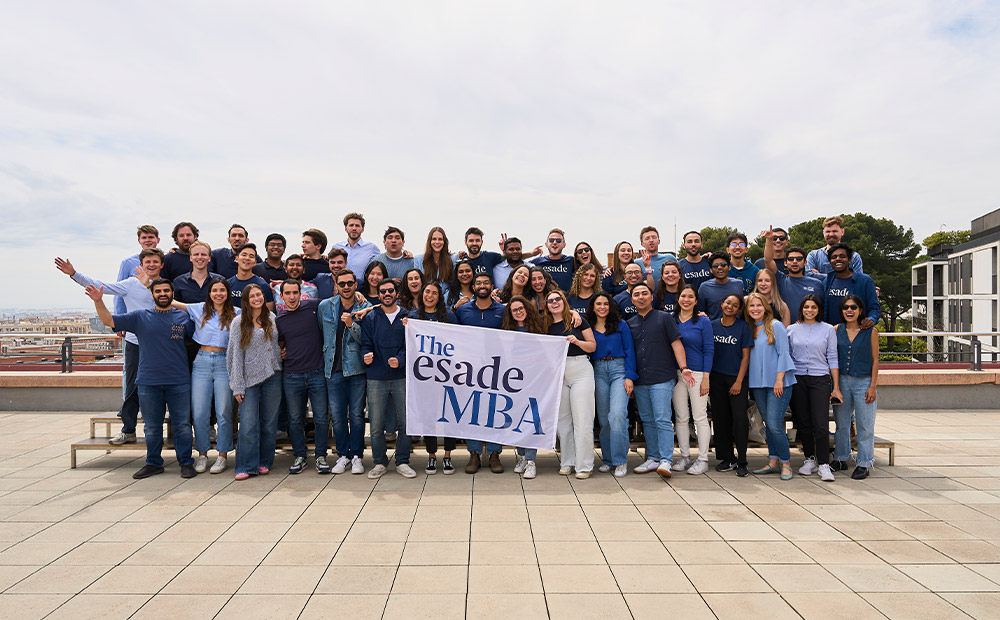
The image shows a large group of MBA participants gathered outdoors during a community activity.
The choice depends above all on what you want to achieve in the next stage of your career:
- If you want to deepen your expertise in a specific functional area and prepare to lead it, a specialized master’s degree may be a better fit for you.
- If, on the other hand, you want to develop more cross-functional leadership, strengthen your management decision-making skills, and learn to make integrated decisions about the business as a whole, an MBA can help you take that step, whether you want to change functions or industries or launch your own business venture.
- It is also worth considering the investment and expected return, as well as your career experience and whether you are available to study full time or combine your studies with work. Whichever option you choose, at Esade you can develop the professional skills you need to take the next step.
Frequently Asked Questions
What is the main difference between a master’s degree and an MBA?
The main difference is that a specialized master’s degree allows participants to deepen their knowledge in a specific area of management, while an MBA develops the ability to lead cross-functionally, integrate different perspectives, and make well-informed decisions about the business as a whole in increasingly complex business environments.
Do I need work experience to pursue an MBA?
Generally, yes. MBA programs are usually aimed at professionals with prior work experience, although requirements vary by program. At Esade, the Full Time MBA requires a minimum of 2 years of professional experience, while the Executive MBA requires a minimum of 5 years.
What is the difference between a Master in Management and an MBA?
Both offer a general management education, but they are aimed at different career stages. The Master in Management is generally designed for recent graduates or participants with limited experience, while the MBA builds on more extensive career experience and uses it to connect what participants learn with real business decisions and situations that they have experienced.
Can I pursue an MBA if I already have a master’s degree?
Yes. Having previously completed a master’s degree does not prevent you from pursuing an MBA. It may make sense if you want to complement a specialization with a more cross-functional view of the business, change functions or industries, take on greater responsibilities, or start a new business venture.
At Esade, we can help you find the program that’s right for you. Explore our Executive Masters and MBA programs and take the next step toward leadership.