
Artificial intelligence (AI) is already part of the everyday reality of higher education. In Spain, 47% of universities have implemented AI-based technologies in their teaching processes (CYD 2025 Report). Among students, 89% use AI in their daily academic lives, although only 34% have received specific training in it at university.
This contrast reveals a key challenge: The lack of an educational framework that prepares students to understand, apply, and lead AI with rigor and strategic vision.
In this context, programs such as Esade’s Bachelor of Business Administration & Bachelor in Business and Artificial Intelligence (as well as its Spanish-language Programa de Especialización en Inteligencia Artificial en los Negocios and Programa de Especialización en Inteligencia Artificial Empresarial) are key to lead and succeed in this new landscape.
The Relevance of Artificial Intelligence in Higher Education
An increasing number of academics are questioning the purpose of artificial intelligence in education. The answer goes far beyond technology; AI has become a true catalyst for innovation in higher education, impacting learning, research, and academic management.
UNESCO notes that the application of AI in education can accelerate progress toward the Education 2030 Agenda (SDG 4). However, it emphasizes that such integration must follow principles of inclusion and equity and adopt a human-centered approach.
It is along these lines that the “Transforming Universities” manifesto, drafted by leading experts at Esade, invites us to consider AI as a lever for transforming universities and to put purpose at the center, avoiding slipping into a purely technocratic model that dilutes the human aspect of their mission.
The question is no longer if AI will transform education, but how to integrate it to achieve more personalized, inclusive, and human learning.
AI tutors are one of the most transformative applications in this field. Platforms such as Khanmigo, developed by Khan Academy, and pioneering initiatives such as Alpha School are paving the way toward an educational model in which AI not only complements teaching but also adapts and personalizes it in real time.
This approach anticipates what the university of the future will look like: A balanced combination of human teaching and automated support.
AI Tools in Higher Education
As previously noted in our article on the future of AI in business, the education sector is one of the leaders in AI adoption. Among the artificial intelligence tools already being applied in higher education are:
#1. AI Tutors: The Future of Personalized Learning
AI-powered virtual tutors are revolutionizing learning in universities and business schools. Unlike conventional chatbots or assistants, they can replace lectures, assess progress, and offer explanations tailored to each student’s pace and level.
Universities such as MIT (Massachusetts Institute of Technology) have already incorporated virtual tutors through their MIT Learn platform and the AskTIM Learn AI Feature, providing instant support and continuous feedback.
#2. Simulations and Role Play for Active Learning
AI-based simulations can recreate business scenarios or ethical dilemmas in real time. Students face complex decisions with immediate feedback, developing critical skills for working life.
#3. Gamification
Gamification has been used in education for years through rewards, levels, and progressive challenges. The new twist is that AI allows us to take these strategies much further, adapting challenges to each student’s pace and constantly fine-tuning the difficulty level.
#4. Virtual Assistants
While AI tutors are designed to teach and adapt learning to each student’s pace, virtual assistants focus on providing academic and administrative support. More and more universities are turning to chatbots to answer frequently asked questions, check calendars, or carry out administrative tasks.
Other Notable AI Tools in Higher Education:
- Simultaneous translation and text-to-speech tools that enhance accessibility and inclusion.
- Intelligent e-learning platforms that automatically adjust learning paths.
- Generative AI for content creation, accelerating the production of cases and academic content.
Advantages and Disadvantages of Using Artificial Intelligence in the Classroom
Like all disruptive innovations, artificial intelligence presents both opportunities and risks. The question is not only how artificial intelligence helps, but also how artificial intelligence affects education in terms of limitations, technological dependence, and ethical dilemmas.
Key Advantages: How AI Helps Education
Optimization and Personalization of Learning
AI systems can automatically adjust the content, difficulty, and pace of activities to each student’s level, reinforcing weak areas and optimizing study time. They can also detect learning patterns to offer almost individualized guidance, even in large classrooms.
Boosting Research and Knowledge Generation
AI is emerging as a driver of acceleration in research processes, reducing time and costs for universities and enhancing the transfer of knowledge to real-world contexts.
Improving Educational Quality
As highlighted in Esade’s DoBetter article on the future of higher education, new technologies such as AI are raising the bar for quality:
- Enabling more accurate and continuous assessment with real-time feedback that improves academic performance.
- Facilitating more dynamic methodologies, such as simulations and real-time data analysis, which bridge academic and professional challenges.
- Providing immediate and efficient access to advanced, up-to-date knowledge.
Inclusion and Accessibility
AI is helping create more inclusive educational environments. Tools such as text-to-speech and real-time translation allow students with disabilities or language barriers to access educational content on an equal footing.
Main Disadvantages and Risks of Artificial Intelligence in Education
- Technological dependency: An overreliance on automation may weaken critical thinking.
- Algorithmic bias: AI systems can reproduce existing inequalities based on biased data
- Privacy and ethics: Managing personal data requires strong governance frameworks.
- Loss of human interaction: Carelessly integrated technology can erode the relational and emotional dimensions of learning.
Artificial Intelligence in Esade Classrooms: Real and Applied Innovation
At Esade, AI is integrated into teaching, research, and training with a practical, ethical, and human-centered approach:
- AI-based business simulations: Allow students to tackle complex management scenarios and train decision-making under pressure in a safe environment.
- AI Tutors in executive, online, hybrid, and MBA programs: At Esade Executive Education Madrid and in the Full-Time MBA, AI is already part of the learning process through virtual tutors and 100% online courses such as Intro to Python and Python for Data Science, which offer personalized support and feedback.
- Intelligent e-learning projects: Adapt learning paths for different profiles in both undergraduate and executive programs.
- Academic research with AI: Esade teams use predictive models and data analysis in fields such as strategy, sustainability, and digital innovation
- Specialized AI programs: Including the Bachelor of Business Administration & Bachelor in Business and Artificial Intelligence double degree and the Spanish-language Programa de Especialización en Inteligencia Artificial en los Negocios and Programa de Especialización en Inteligencia Artificial Empresarial.
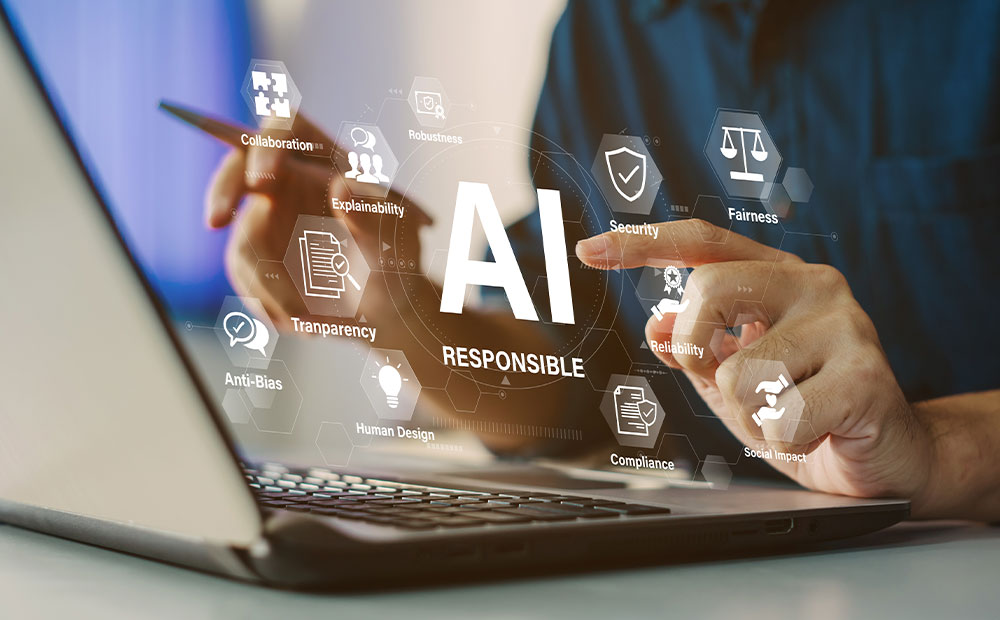
- Ethics and responsible leadership: AI is integrated into executive education within a value-based framework, aligned with Esade’s mission to shape conscientious, competent, compassionate, and committed leaders.
Join Esade and prepare to not only master AI, but also lead its application with an ethical and strategic vision. Discover the program that best suits your goals.